Applications
Thermal Wave Imaging has played a leading role in bringing thermography from the research lab to the real world of NDT, offering results comparable to ultrasound, radiography, eddy current and laser shearography for many applications. We’ve been providing solutions to our customers since 1993, many of them industry firsts. However, application requirements are constantly changing to meet advances in materials and manufacturing processes, and we continue to learn and move thermography forward to meet new challenges. If you don’t see an application here, ask us. We’ve probably done it (or are working on it now!)
Large Area NDT
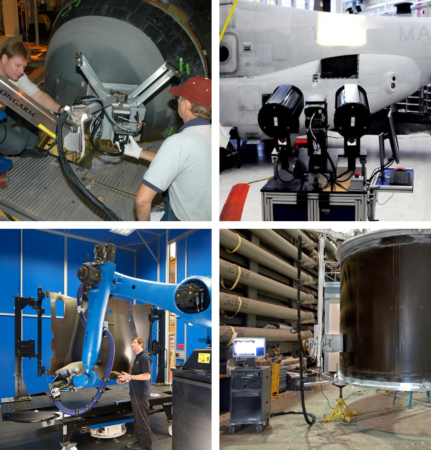
TWI systems offer fast, cost-effective NDT for large-scale applications, particularly for rough, porous, or thin materials where ultrasound may be difficult to use. In applications ranging from helicopter rotor blades to space vehicle wings and fairings, TWI systems are the #1 choice, based on detection sensitivity, speed, ease of use and return on investment
- Optimized workflow for large-scale
- Economical alternative to large-scale UT
- Non-contact (for rough, porous or hydrophilic surfaces)
- Fastest thermography results (Total Inspection Time)
NDT of Complex Structures
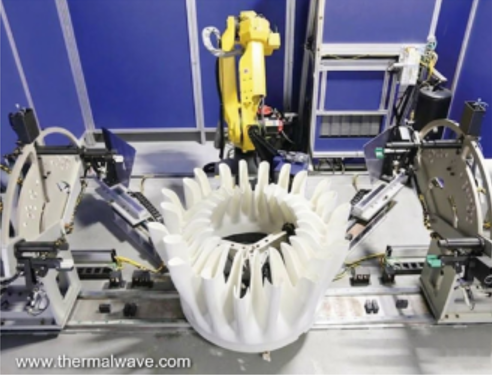
Evaluation of thermography for NDT is often based on results from planar test standards with flat-bottom holes or inserts. While those results are significant, they don’t tell the whole story when it comes to complex, non-planar structures, which require careful consideration of numerous additional optical, thermal and engineering issues. After evaluating all other methods (including thermography) customers choose TWI systems for NDT of complex composite, ceramic, and metal parts.
- Complex ceramics (exhaust nozzles, mixers)
- Corners and radii
- Pi-joints
- Fastest thermography (compared to lock-in, long pulse)
- Optimized software for analysis of complex structures
Polymer Composites
TWI systems are the #1 choice for manufacturing QA as well as maintenance of composite parts in the aerospace and automotive industries. Our hardware and software tools have been widely recognized for their sensitivity and accuracy, while optimizing workflow and minimizing total inspection time.
Manufacturing QA
- Sandwich structures – skin to core disbond
- Foreign Object Debris (FOD) in cured and uncured parts
- Defect size / depth measurement
- Delamination
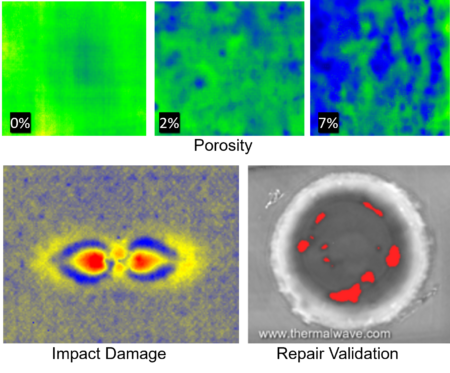
- Porosity
In-service
-
- Repair validation
- Impact damage
- Water intrusion
Ceramics / CMC / TBC
Ceramic materials, coatings and CMCs play an increasingly important role in space and defense manufacturing, but present challenges to many NDT technologies. TWI has been at the forefront of providing ceramic NDT solutions dating back to the NASA Space Shuttle Return to Flight program in 2004, when our EchoTherm system was selected to inspect the C/C leading edge and nose cone of all shuttle flights. Today, leading OEMs use TWI systems for inspection of ceramic parts at every stage of the manufacturing process.
- Ox-Ox (free standing and coatings) QA
- Stabilized zirconia, C/SiC coating adhesion and measurement
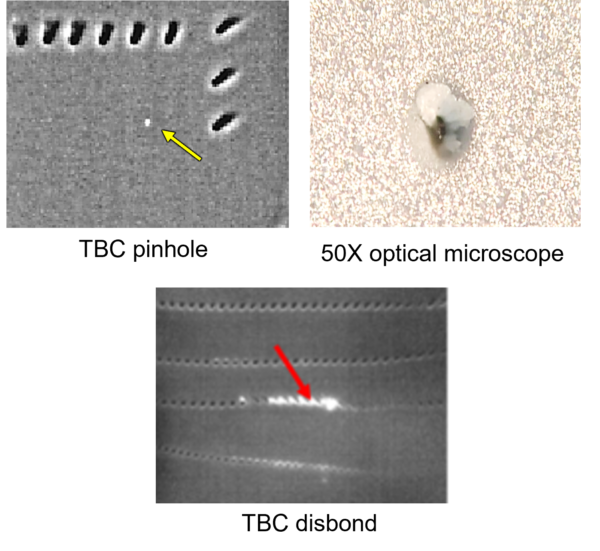
- TBC crack and pinhole detection
IGT / Aero Blades and Vanes
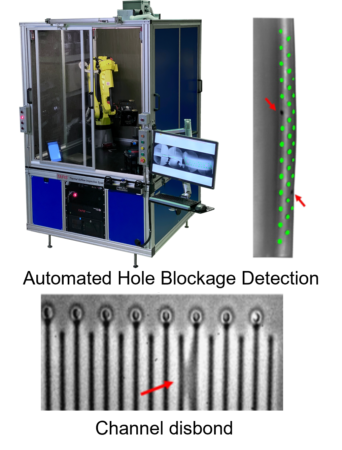
TWI has redefined cooling hole and channel blockage inspection for aero turbine engine airfoils and IGT buckets. Our fully automated robotic solution is the new inspection benchmark offering unprecedented precision, speed and reliability. Major OEMs now use TWI systems to replace conventional testing methodologies (e.g. pin gauge, water flow, wax).
In addition to detecting hole and channel blockages, TWI technology can also measure TBC thickness, detect TBC delamination and detect cracks for land and aerospace-based turbine components.